
We are updating our WordPress integration to use the WordPress REST API, as the legacy XML-RPC connection is being phased out. To ensure uninterrupted publishing, you'll need to reconnect the WordPress channels and, if you attach Scompler properties as custom fields, register them in WordPress.
When you link a WordPress site to Scompler, you can both import your articles and pages into the platform and export content to WordPress from Scompler.
Prerequisites:
- You have administrator rights
- You have installed WordPress in the Marketplace
Connect a WordPress Site
- Navigate to Project Settings > Apps > WordPress > Credentials.
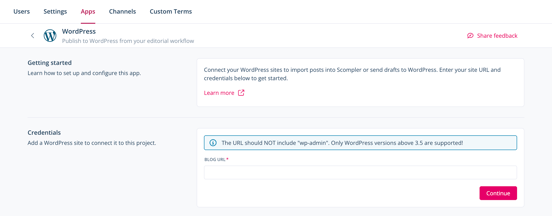
- Under Blog URL, enter the URL of your blog.
- Click Continue.
Depending on the hosting type of your website, the section expands (4) or the WordPress login screen opens (5). - For self-hosted WordPress sites, enter your username and the application password, then click Connect.
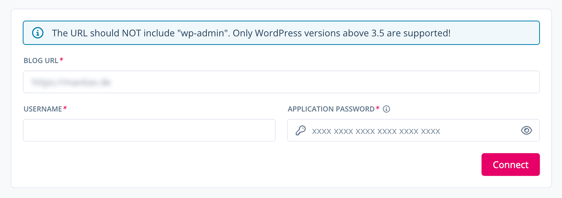
The Application Password does not refer to your account password. Learn how to create an application password.
- For WordPress.com sites, if required, log in to your WordPress account, then allow Scompler to access your site.
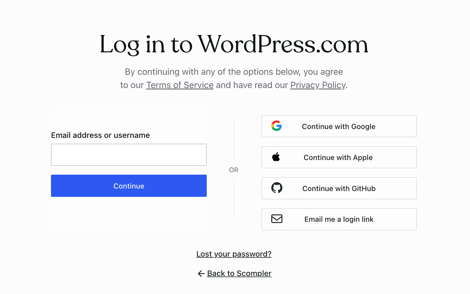
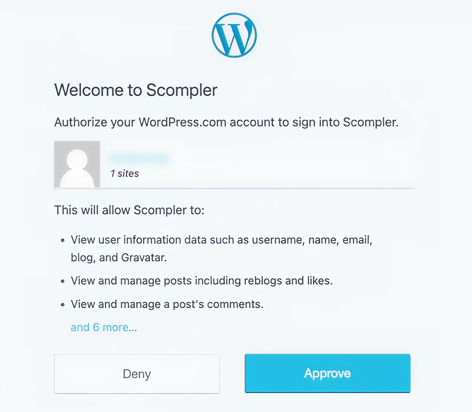
You have connected your WordPress site to Scompler. The connection displays under Connected Sites. Scompler recognizes all WordPress websites that are linked to your WordPress account.

The 200 most recent posts and pages are automatically imported into Scompler.
Reconnect a WordPress Site
- Navigate to Project Settings > Apps > WordPress > Connected Sites.
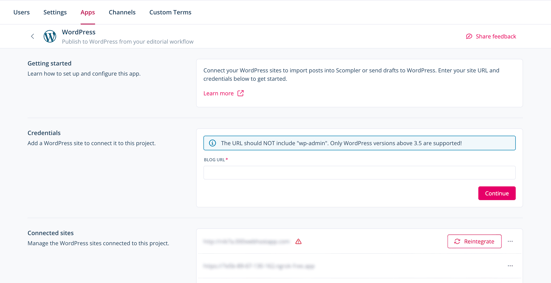
- Click Reintegrate for a connected site displaying a warning icon.

Depending on the hosting type of your website, a dialog to edit your CMS connection (3) or the WordPress login screen opens (4). - For self-hosted WordPress sites, enter your username and the application password in the dialog, then click Save.
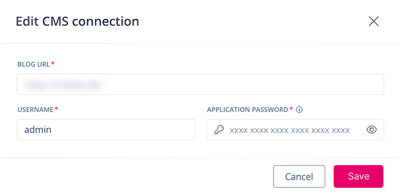
- For WordPress.com sites, allow Scompler to access your site.
You have reconnected your WordPress site to Scompler. The warning icon and Reintegrate button next to the connected site are removed. If you have attached Scompler properties as custom fields in WordPress, you’ll now need to register these.
Register the Custom Fields (Scompler Properties) in WordPress
If you attach Scompler properties as custom fields in WordPress and they no longer appear after reconnecting your channels, your WordPress site must be configured to accept them through the WordPress REST API. This may be required for self-hosted WordPress sites as well as sites hosted on WordPress.com or through Jetpack.
To check whether this option is enabled, navigate to Project Settings > Settings > Export > WordPress: Attach Scompler properties as custom fields.
Ask your WordPress developer to register the following custom fields for the corresponding post type. Each field must:
-
be exposed to the REST API (
show_in_restenabled) -
store a single value
-
be writable by users who can edit posts
-
use the data type shown below
|
Custom field (meta key) |
Type |
|
scompler_id |
integer |
|
scompler_language_name |
string (text) |
|
scompler_language_slug |
string (text) |
|
scompler_story |
string (text) |
|
scompler_topic |
string (text) |
|
scompler_category |
string (text) |